
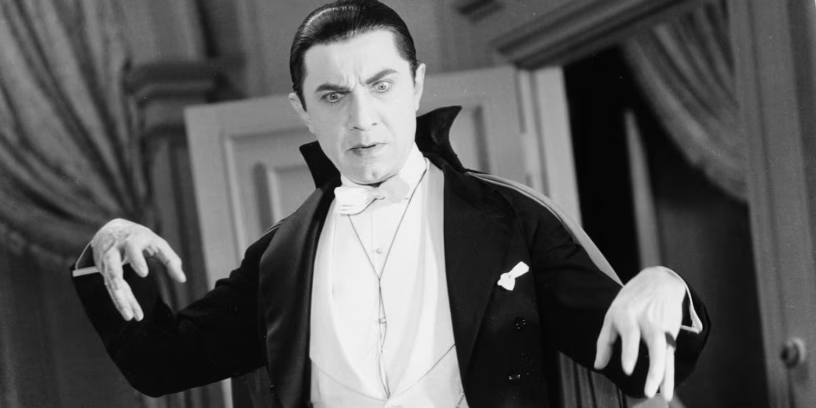
Picture this: it’s 1931, the Great Depression has America in its grip, and you’re slipping into a darkened theater. Bela Lugosi steps into the flickering light, his cape swirling like a shadow come alive, and utters words that send chills racing down every spine. That moment with Dracula didn’t just start a film; it tapped into something primal, a fear wrapped in velvet seduction that still echoes in every vampire story we tell today.
This article takes you through the standout horror movies of the 1930s, from the Universal classics that built empires to the overlooked gems that pushed boundaries in unexpected ways. We’ll break down their stories, the stars who brought the nightmares to life, and why they mattered so much back then – and still do now. Along the way, we’ll connect the dots to the cultural storms of the era, like economic despair and looming global tensions, and trace their ripples into modern horror up through 2026. These films weren’t just scares; they held up mirrors to our souls.
Introduction
The 1930s marked a turning point for horror cinema, one where the silver screen started churning out monsters that felt both larger than life and uncomfortably close to home. This was the sound era’s big breakout for the genre, right after the silent film’s experimental whispers. The Great Depression left people scraping by, hungry for escape, while memories of World War I’s trenches lingered like ghosts. Into that mix came films that turned personal anxieties into celluloid spectacles – fears of job loss morphing into tales of undead economies, scientific hubris mirroring unchecked ambition. Monsters and supernatural beings stepped out of the fog to probe morality, identity, and what it really means to be human. Standouts like Tod Browning’s Dracula (1931) and James Whale’s Frankenstein (1931) laid the foundations, delivering unforgettable performances and stories that dug deep.
What makes this decade so fascinating is how these movies captured a society’s pulse. They weren’t made in a vacuum; Universal Studios saw profit in frights during tough times, kicking off what we’d call the Golden Age of Horror. Box office numbers prove it – Dracula raked in over $700,000 on a $355,000 budget, a lifeline for theaters. Today, as Dyerbolical dives into these classics at dyerbolical.com/about-us/, we see their DNA in everything from Guillermo del Toro’s gothic visions to the latest streaming slashers. This piece unpacks the key films, their origins, characters, and lasting cultural punch, showing exactly how they molded the genre we love.
The Birth of Horror Cinema: Dracula and Bela Lugosi
Tod Browning’s Dracula (1931) gets the credit for igniting horror’s golden age, and it’s hard to argue otherwise. Adapted from Bram Stoker’s 1897 novel, it stars Bela Lugosi as the count, whose hypnotic stare and thick Hungarian accent locked in the vampire blueprint forever. That line, “I never drink… wine,” lands like a velvet glove over a steel fist – playful, yet dripping with menace. It lets viewers flirt with taboo ideas of bloodlust and desire, all while the gothic castles and foggy nights pull you under.
Timing was everything here. Released amid Prohibition’s end and shifting sexual mores, Dracula mirrored a culture wrestling with old rules crumbling. Audiences ate it up, but censors nitpicked the sensuality, leading to cuts that toned down the bite. Browning’s circus background shines through in the eerie, stylized visuals – think armadillos as rats for budget reasons, a quirky choice that adds unintended charm. Lugosi’s career skyrocketed then stalled; typecast, he never escaped the cape, a tragic irony that fuels fan fascination. Fast-forward, and Robert Eggers’ 2024 Nosferatu remake nods directly to this, with Bill Skarsgård channeling Lugosi’s allure amid modern effects. Why does it stick? Because Dracula embodies eternal seduction laced with doom, a template for Anne Rice’s worlds or What We Do in the Shadows‘ comedy. It matters as the spark that proved horror could be both art and moneymaker.
The Evolution of Horror: Frankenstein and Cultural Commentary
Hot on Dracula‘s heels came James Whale’s Frankenstein (1931), reimagining Mary Shelley’s 1818 novel with a focus on tragedy over terror. Colin Clive’s Dr. Henry Frankenstein is the ultimate mad scientist, wild-eyed and obsessed with cheating death. His triumphant yell, “It’s alive!” during the lab storm scene, captures that razor-edge thrill of playing God – pure ambition exploding into regret.
Boris Karloff’s Monster steals the show, flat-headed and bolted-necked, moving with a lumbering grace that begs sympathy. Makeup wizard Jack Pierce spent hours bolting on layers of cotton and greasepaint, creating a look that’s endured. The film veers from the book by humanizing the creature, showing drownings and fire as society’s cruel response to the ‘other.’ This hit during Depression-era paranoia over immigrants and outsiders, whispering that rejection breeds monsters. Whale, a gay director in a repressive time, infused queer subtext too – the creature’s loneliness mirroring hidden lives. Its influence? Massive. Mel Brooks parodied it in Young Frankenstein (1974), Guillermo del Toro’s Crimson Peak (2015) echoes the gothic, and Maggie Gyllenhaal’s 2025 Frankenstein with Jacob Elordi promises fresh twists. These elements matter because they turned horror into a lens for empathy, asking if we’re all just one rejection from snapping.
Lesser-Known Horrors: Doctor X and White Zombie
Michael Curtiz’s Doctor X (1932) mixes horror with whodunit flair, starring Lionel Atwill as the sinister Dr. Xavier, a surgeon with a taste for human flesh. Murders pile up, experiments unravel, and the reveal packs a punch. Shot in early two-color Technicolor, those green-tinted night scenes pop even now, a tech flex that made it stand out when most films were black-and-white drab. It bridged detective yarns like Curtiz’s later The Maltese Falcon with scares, proving horror could puzzle as well as petrify.
That same year, White Zombie dropped with Bela Lugosi as Murder Legendre, the voodoo master of a Haitian sugar plantation. As the first full-length zombie flick, it pulls from real Vodou lore – not the slow-shambling undead of later George Romero, but hypnotized slaves under Legendre’s powder. Madge Bellamy’s Neil is zombified for love’s sake, her glassy eyes haunting. Shot on a shoestring in the Los Angeles hills doubling as Haiti, it captures colonial dread and exploitation. Lugosi chews scenery masterfully post-Dracula slump. Its legacy? Paved for I Walked with a Zombie (1943) and modern takes like The Serpent and the Rainbow (1988). These films matter for expanding horror’s toolbox – color tricks, cultural myths – showing the genre could thrive beyond Universal’s gloss.
Folklore and Fear: La Llorona and The Invisible Man
La Llorona (1933), a Mexican production directed by Ramón Peón, brings the folktale of the weeping woman who drowned her kids in grief to life. Though not Hollywood, it snuck into U.S. theaters, seeding Latin American horror with cries echoing loss and rage. Ties to Depression struggles hit hard – families torn by poverty mirroring the ghost’s torment. This early sound entry influenced later waves, like the 2019 The Curse of La Llorona, blending folklore with Hollywood polish.
James Whale ramped up sci-fi dread with The Invisible Man (1933), from H.G. Wells’ novel. Claude Rains, voice-only as the title scientist, bandages up after his invisibility serum backfires into madness. Those rampages – bikes toppling, voices disembodied – use wires and matte tricks brilliantly for the era. Rains’ descent from genius to killer probes isolation’s toll, a theme that resonated as folks felt unseen in breadlines. Whale’s direction adds sly humor amid horror. Echoes persist in Hollow Man (2000) and the 2020 Leigh Whannell remake, starring Elisabeth Moss. Why care? It fused brains with frights, warning that erasing yourself might erase your humanity too.
Morbid Curiosities: The Monkey’s Paw and Maniac
The Monkey’s Paw (1933), adapting W.W. Jacobs’ 1902 story, warns against fate’s strings. A family gets the paw – three wishes, gruesome prices. Dad’s plea revives their dead son as a knocking horror outside, forcing a heartbreaking counter-wish. Low-budget but potent, it nails greed’s backlash, perfect for Depression dreams dashed by reality. That pounding door still ranks among horror’s simplest, scariest beats, inspiring The Twilight Zone and Dead Silence (2007).
Dwain Esper’s Maniac (1934) dives into psych terror, following a crazed assistant who steals a mad scientist’s serum, sparking murders and paranoia. Bill Woods plays the unraveling lead in this exploitation quickie, hyped as a shocker. Rough edges and real-life crime sensationalism stirred backlash, but it boldly tackled insanity when mental health was taboo. Ties to Freaks (1932) via Browning vibes. Matters because it dragged horror indoors, to the mind’s fractures, foreshadowing Psycho (1960).
Evolving Monsters: Bride of Frankenstein
James Whale’s Bride of Frankenstein (1935) tops many lists as horror perfection, sequel and soul-deepener to the original. Elsa Lanchester’s Bride, with wild hair and hiss, electrifies her debut – rejecting the Monster in a spark of life that breaks hearts. “She’s Alive!” flips the first film’s cry, probing love’s limits amid freakshow flair. Whale layers in camp and pathos, with Dwight Frye’s blind hermit adding tenderness.
Shot resisting studio pressure, it boasts opulent sets and a finale of mutual destruction. Lanchester’s look – inspired by ancient art – symbolizes rejected femininity. Cultural hit: subtext on misfits resonated pre-WWII. Influences Edward Scissorhands (1990), The Bride! (1985). In 2026, amid reboots, it reminds us monsters crave connection most.
Haunting Visions: The Raven and Werewolf of London
The Raven (1935) pits Boris Karloff and Bela Lugosi in a Poe-fueled frenzy. Lugosi’s surgeon, Poe-obsessed, crafts torture devices amid laughs and gore. Stylish sets and dual-star power make it a genre peak, blending psych horror with camp.
Stuart Walker’s Werewolf of London (1935) unleashes Henry Hull as Dr. Wilfred Glendon, bitten into lunar madness. Rare flower cure fails; transformations symbolize control’s loss. More tragic than feral, it set werewolf templates before 1941’s The Wolf Man. Explores identity’s horror, relevant then and in 2025’s Blumhouse remake.
The Influence of The Golem
Paul Wegener’s The Golem (1920), a German expressionist gem whose shadow loomed large into the 1930s, draws from Jewish legend. Wegener’s clay protector for Prague’s ghetto turns destructive when misused. Expressionist angles and shadows amplify creation’s perils, echoing Frankenstein.
As Europe tensed pre-WWII, its themes of otherness and power hit raw nerves. Influenced Universal’s monsters; modern nods in del Toro’s Pinocchio (2022). Presses us to question who the real monsters are.
Conclusion
The 1930s horror films forged the genre’s spine, birthing icons and themes that pulse today. Dracula, Frankenstein, Bride of Frankenstein thrilled while dissecting fears, ethics, humanity. They built modern horror’s playground.
These stories urge us: fears evolve, but reveal our cores. What monsters lurk in 2026’s chaos? Their sparks light tomorrow’s tales.
Read about horror movies of the 1920s here
Find us on X here
Bibliography
Skal, David J. The Monster Show: A Cultural History of Horror. W.W. Norton, 2001.
Rhodes, Gary D. White Zombie: Anatomy of a Horror Film. McFarland, 2001.
Brunas, John, et al. Universal Horrors: The Studio’s Classic Films, 1931-1946. McFarland, 1990.
IMDb entries for Dracula (1931), Frankenstein (1931), and others.
Everson, William K. Classics of the Horror Film. Citadel Press, 1974.
Tudor, Andrew. Monsters and Mad Scientists: A Cultural History of the Horror Movie. Blackwell, 1989.
Recent coverage: Variety on 2024 Nosferatu and 2025 Frankenstein projects.
Got thoughts? Drop them below!
For more articles visit us at https://dyerbolical.com.
Join the discussion on X at
https://x.com/dyerbolicaldb
https://x.com/retromoviesdb
https://x.com/ashyslasheedb
Follow all our pages via our X list at
https://x.com/i/lists/1645435624403468289